

Our Monthly Newsletter
Helpful tips for family caregivers
April/May 2024
A growing number of healthcare providers are offering home-based services without the usual limitations of Medicare. Some qualify for a relatively new Medicare program. Others are offering their services on a private-pay basis. The convenience and ability to get the care you want may make it worth checking out. In our middle article we explain why chronic inflammation is becoming such an important factor in medicine. Last, we look at specially designed clothing that can make it easier for the person you care for to get dressed on their own.
Home visits are in!

If the person you care for needs therapy or other medical services but has trouble getting out, house calls are a great solution. Historically, Medicare has had strict rules for home-based services and how “homebound” a patient must be for the services to be covered. It also limits the number of visits per week or the number of weeks allowed for care at home. In addition, the rules typically require a certain level of improvement in the patient for services to continue. Some of these rules are loosening. It’s worth checking. If you find Medicare won’t cover a service, you may have the option to pay privately.
Physicians. If your relative is frail and you don’t want the drive or the wait in the doctor’s office, consider finding a primary doctor who has arranged with Medicare to make house calls. Check out the American Academy of Home Care Medicine.
Rehabilitation therapists. Hiring privately allows for more visits per week or for a longer time period if your loved one’s progress is slow. This can mean the difference between a full versus a partial recovery. Or even better quality of life, with your relative retaining as much functioning as possible even if they aren’t “improving.”
- Physical therapists help with exercises to improve movement and relieve pain.
- Occupational therapists identify exercises and “adaptive technology” to make it easier to perform daily tasks of living.
- Speech pathologists suggest exercises and techniques for swallowing and speech problems. They also teach strategies to offset logical thinking problems due to dementia.
Psychotherapists. Is your loved one reticent to seek counseling? Home visits can feel more like a friendly chat. Your relative may feel safer and more in control on their home turf. Plus, house calls also allow for more privacy if they have concerns about being seen walking into a counselor’s office. Ask the therapist whether Medicare will cover home visits.
Check for quality. There are fewer guardrails on quality for home-based providers. Ask for references and always ask if they are licensed or board certified. Get their license number and look it up to see if there have been complaints or suits against them. If they can’t give you a license number, you might want to think twice.
Return to topWhat is "inflammaging"?

Chronic inflammation is like the body (your “house”) catching fire. We have all dealt with acute inflammation. It comes with injury, such as a sprained ankle. Or infection, such as staph, bronchitis, etc. Inflammation is a sign that the body’s defenses are rushing in. In the normal course of events, healing occurs and the immune system stands down.
With age, our immune system becomes less effective. It overproduces cytokines and other inflammatory cells. If it doesn’t stand down, it can last for weeks, months, or even years. This is called “inflammaging.” Chronic overreaction of the immune system is hard on tissues and organs. In effect, the immune system is misreading cues and behaving as if there’s an ongoing 10-alarm fire. Under this state of siege, organs become unable to do their jobs effectively or to repair themselves well.
The potential for such immune malfunction begins around age fifty and increases sharply at age sixty and above. It may be the reason the occurrence of diseases such as heart disease, diabetes, and dementia increases significantly after age sixty-five. They are malfunctions of different body systems—the heart, the pancreas, the brain—but inflammaging is what opens the door. In the worst case, the body starts attacking itself—creating what’s called an “autoimmune condition”—or starts growing cancer cells.
Not all inflammation is bad, of course. Constant dosing of antiinflammatory drugs, for instance, is not the answer. We need the inflammatory response to address an acute infection or injury. It’s simply that you want the right amount of inflammation for the appropriate amount of time.
In subsequent articles we will talk about ways to detect chronic inflammation and what can be done to reduce it (in your loved one and for yourself!).
Return to topAdaptive clothing
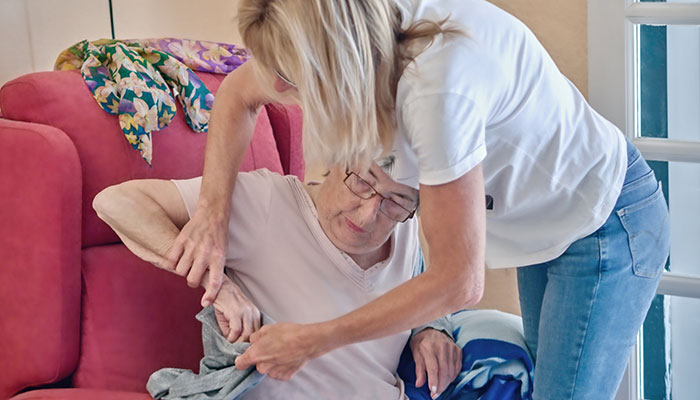
If you have dressed a relative with dementia or assisted a family member with Parkinson’s, you know there are challenges involved. Dressing requires physical coordination, fine-motor skills, flexible joints, and range of motion. Not being able to dress oneself is both frustrating and embarrassing. Fortunately, clothes designers have developed garments with important adaptations.
Adaptive clothing typically incorporates these features:
- Easy closures. Look for snaps, hook-and-loop fasteners, Velcro, or magnets. (Avoid magnets if your loved one has a pacemaker.)
- Pull-over shirts or dresses that have no closures. With broader necklines and loose sleeves, there is no need to fuss with buttons or zippers. These garments do, however, require the ability to lift one’s arms above one’s head.
- Elastic waistbands. No zipper or belt. The easy on and off is especially helpful when incontinence is involved. Elastic is also forgiving of fluctuations in weight.
- Opening down the back or sides. These garments are particularly useful when incontinence and mobility are issues. They have a significant overlap of fabric at the openings. They give you greater access as the caregiver while preserving your family member’s modesty by keeping their front covered.
Other qualities to keep in mind
- Bright colors for greater visibility. If your relative has dementia and tends to wander off, bright colors make it easier to spot them.
- Soft materials and flat or minimal seams for sensitive skin. Avoid wool or other scratchy fabrics if the person you care for has delicate skin. Also steer clear of polyester because this fabric can develop a static charge and give off a painful, unexpected spark.
- For bras, look for front-closure or pull-on styles.
- For shoes, look for slip-ons, extra wide sizes, and no laces.
Help preserve your loved one’s dignity by getting them clothes that support their independence. Google “adaptive clothing” to find online vendors.
Return to top